In this video interview, we discover a notable collection of scientific calculators: that of Fabio Frascati, a mathematician by training and freelance data analyst. Fabio has been collecting calculators for over 20 years and today has around 200 examples, distributed between basic and advanced models.

Read the full video transcript →
We are talking about basic and advanced scientific calculators (programmable and graphic) that cover a time span of approximately 40 years, from 1985 to today.
Sunlux - entry level calculator
The simplest model shown in the video is a Sunlux, a calculator that performs the four basic operations, plus percentage, root and some memory functions.
A scientific calculator must include the following functions:
- trigonometric
- exponential
- logaritmiche
- statistics
Therefore, the Sunlux represents only an entry level model.
Precision 2374 - traditional scientific calculator (240 functions)
The Precision 2374 is a scientific calculator with 240 functions, a classic among scientific calculators in general.
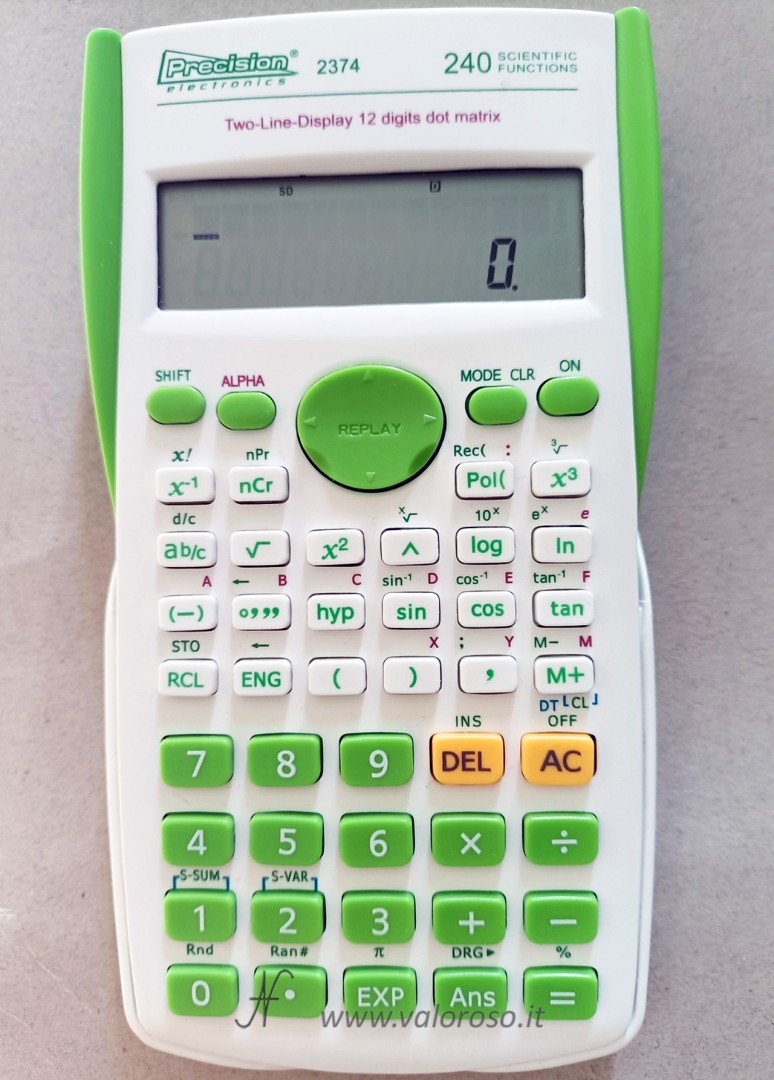
Fabio underlines how manufacturers often change the color or external shape, but the internal electronic board remains essentially the same.
Today, scientific calculators start with around 50 functions and can exceed 600 in the most advanced models. The Precision 2374 therefore represents a very common intermediate range on the market.

Casio FX-7000G (1985) - the first graphing calculator
The Casio FX-7000G, launched in 1985, is the world's first graphing calculator.
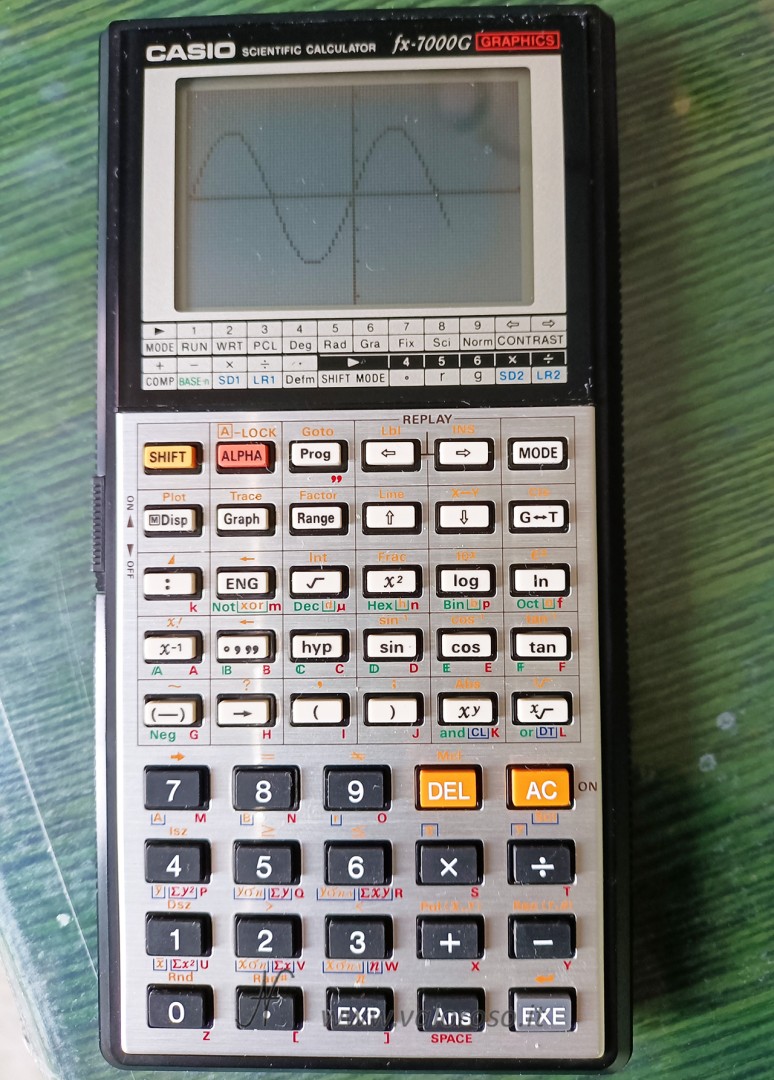
Main features:
- Dot matrix LCD display
- Ability to graph mathematical functions (e.g. sine function)
- Front and rear body in aluminium
- Side power button
Fabio also owns a "mint" example, which has never been released from the original packaging.
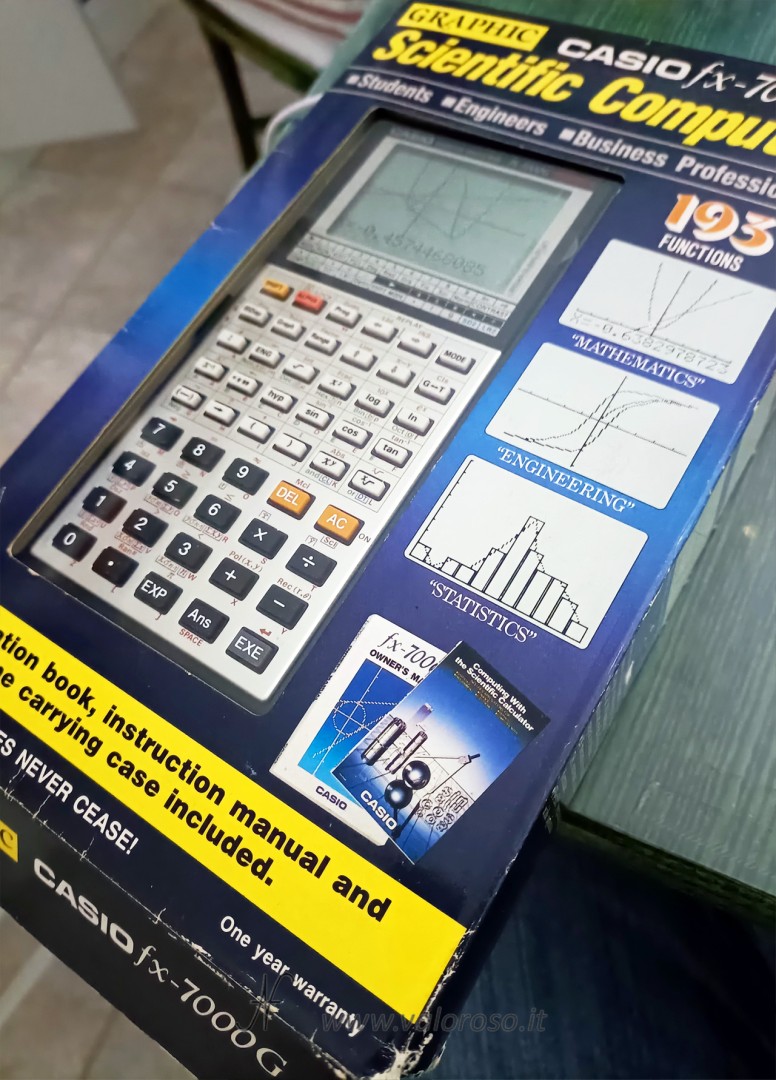
With this graphic calculator the real technological leap is made: the display pixels are activated in sequence to represent the progress of a mathematical function. Not just visualization of the numerical result: with the Casio FX-7000G you can carry out a real function study.
Casio OH-7700GE - graphing calculator for overhead projector
The Casio OH-7700GE is one of the most particular models in the collection, dating back to the early 1990s.
Distinctive features:
- Transparent display
- Designed for use with an overhead projector
- Projection on the wall via blackboard mirror
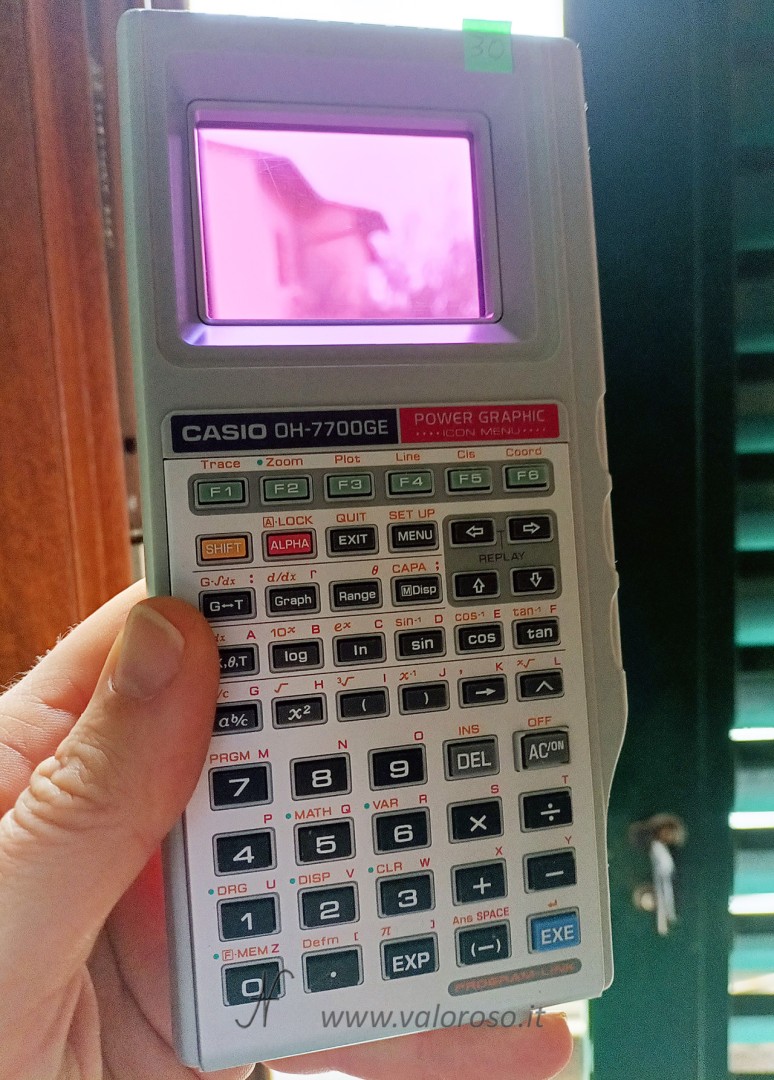
The name “OH” stands for OverHead Projection Unit. The display receives light from the overhead projector lamp below and allows enlarged projection for educational use. The manual recommends taking frequent breaks because the blackboard lamp tends to heat up the calculator a lot.
Texas Instruments TI-92 Plus (1999)
The Texas Instruments TI-92 Plus is a large-sized programmable graphical calculator.
Main features highlighted during the chat with Fabio:
- Tastiera QWERTY
- “Joypad style” design, use with both hands
- Multiple Enter keys
- Ability to run programs
- Possibility to load and consult text files (TXT)
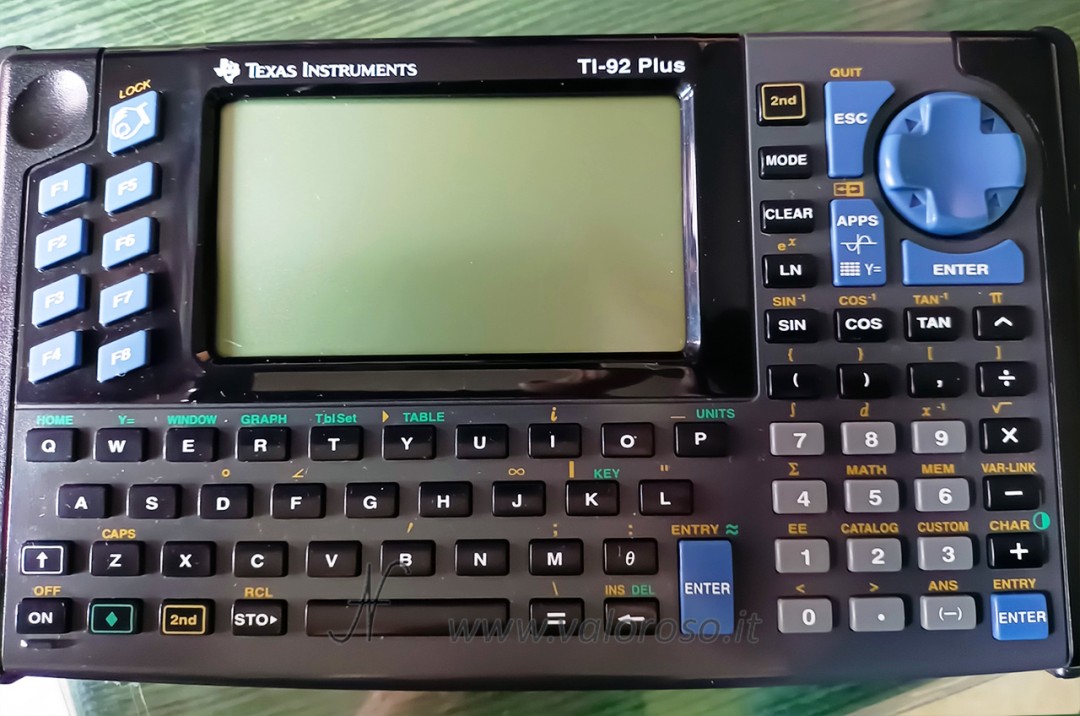
It has been banned in some university exams, especially in the United States, due to the presence of the QWERTY keyboard and the possibility of inserting notes or programs.
Casio FX-9860G Slim (2009)
The Casio FX-9860G Slim, from 2009, has the following innovative features:
- High contrast display
- Backlight
- Integrated help
- Compattezza (Fold Handheld Calculator)
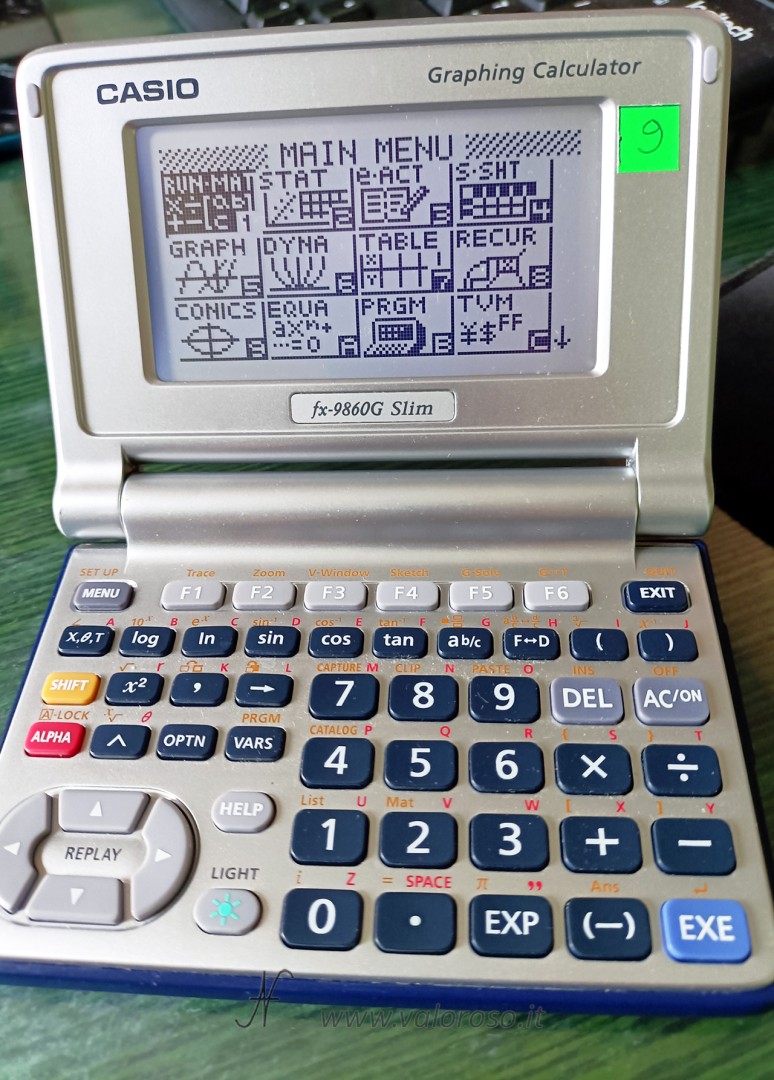
The improvement in display quality is evident: in the interview video, the sine function is tracked more clearly than on models from the 1980s.
Casio ClassPad 300 (2003)
The Casio ClassPad 300, from 2003, introduces even more advanced features.
Technical specifications:
- Display verticale 160 x 240 pixel
- Virtual on-screen keyboard
- Splitting the screen into two simultaneous applications
- Interfaccia pen-based (pen touch, non touch a dito)
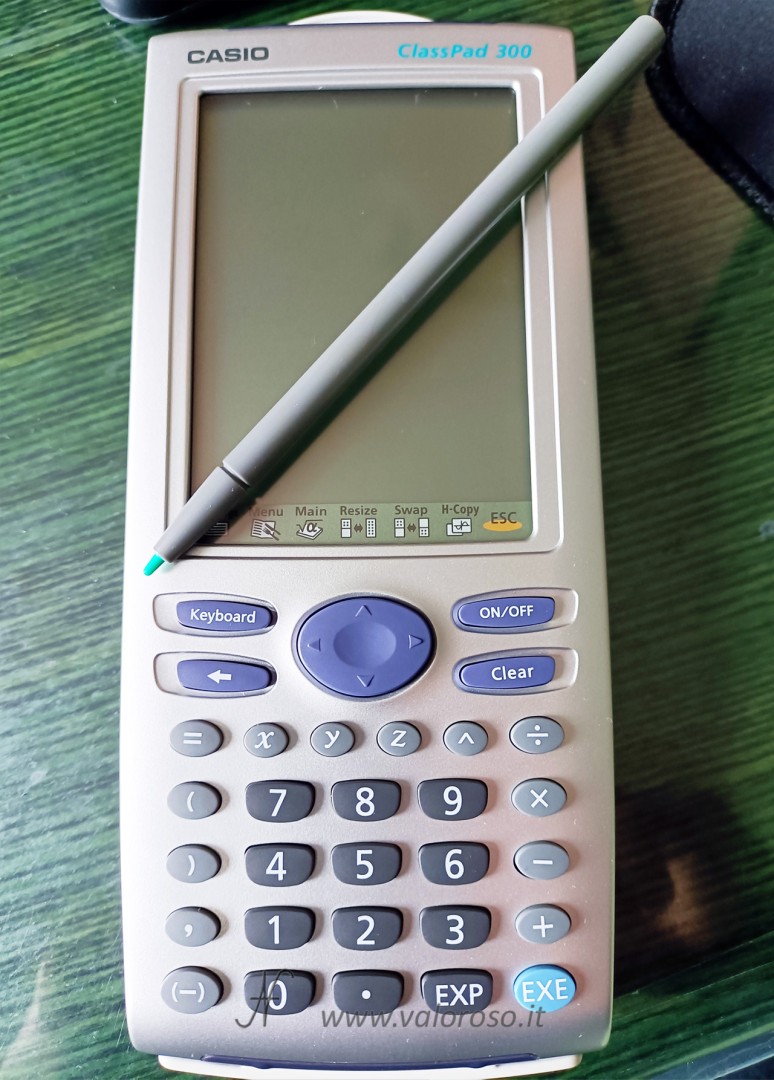
This programmable graphing calculator allows you to work on multiple applications at the same time, view graphs and take advantage of a large vertical display.
Fabio Frascati
Fabio Frascati is a mathematician by training and a freelance data analyst. He has been collecting scientific calculators for over 20 years. From calculation tools for university study, calculators quickly became objects of collector's interest. Today its collection includes around 200 basic and advanced scientific models (programmable and graphic). To use calculators to the fullest and satisfy his curiosity, study hundreds of pages of manuals!

Subscribe to my channel and stay up to date
To stay updated on topics relating to computers and vintage electronics, I invite you to subscribe to the YouTube channel @ValorosoIT and to activate the notification bell to not miss the next videos. They are also present on Tiktok, Instagram, Facebook, Threads ...