This time I want to start with a big thank you to Franco Sassaro of Microsystem Engineering for this important donation of vintage computers, electronic equipment, PC cards, development tools and materials used throughout his professional career.

It all started with a message from him. His laboratory had to be cleared out as the business was being transferred to an affiliated company, and various items accumulated over the years had to quickly find a new home. Otherwise, much of this equipment would have risked ending up in landfill.
Franco had told me there was an IBM AT computer, an Advantech programmer, some AT bus cards and some ASEM computers. I rushed to his laboratory, mainly to see the IBM AT, which I had wanted to add to my collection for some time. When I arrived, however, I realized there was much more interesting material than I had expected.
This is exactly the kind of case that shows why, when wondering what to do with an old computer, it is worth thinking twice before throwing it away. Hardware or equipment that a company no longer uses or plans to dispose of may still be of technical, historical and collector interest.
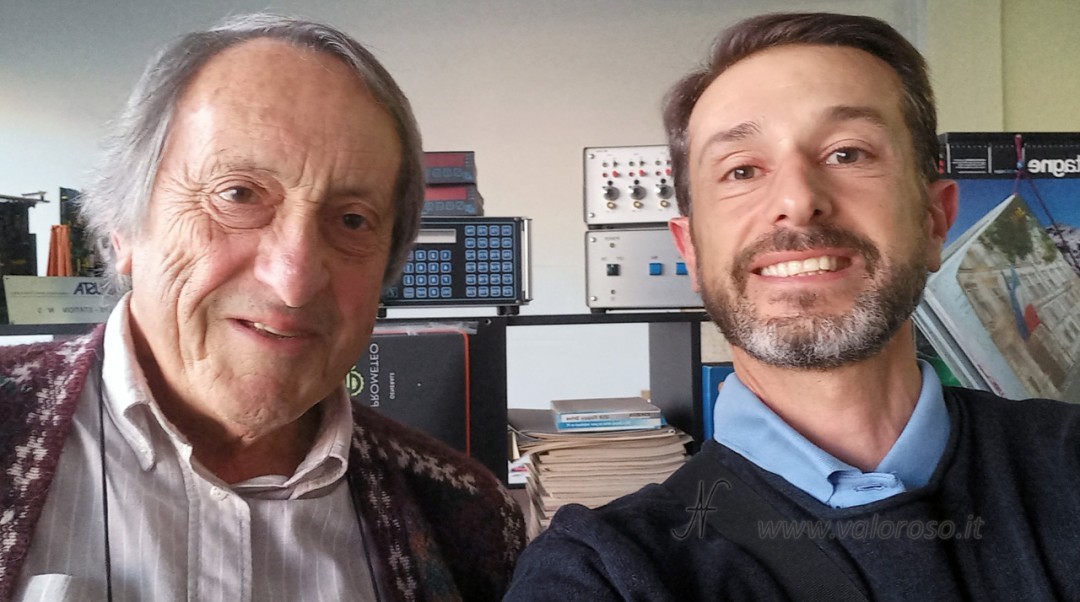
Franco Sassaro: from analog electronics to microprocessors
During our meeting, I also had the opportunity to hear Franco Sassaro describe some highlights from his long career in electronics.
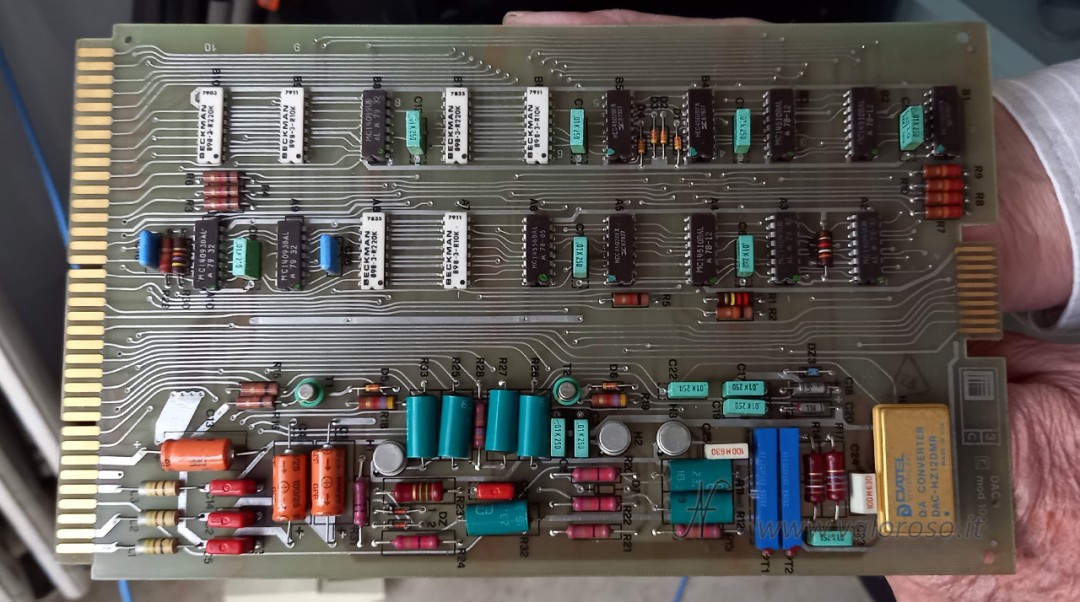
His professional career began in analog electronic design. While working as an employee, he was already designing professional electronic boards, some of which were also built to military specifications.
This meant not only designing the circuit correctly from an electrical point of view, but also taking into account component characteristics, heat dissipation, spacing and component placement on the board, as well as specific manufacturing requirements.
Franco also showed me one of these boards, which is still very interesting to examine today because of the orderly component layout, the professional construction and the presence of both analog and digital circuits in the same piece of equipment.
As electronics evolved, Franco gradually moved into digital logic and microprocessors as well.

One of the processors he studied in greatest depth was the Intel 8085. He became so proficient with it that Intel itself contacted him to teach courses on microprocessor programming.
Franco later founded Microsystem Engineering, bringing these skills into his own business and working on the design of electronic systems and control equipment.
Part of the company's work also involved highly specialized applications. Franco told me that Microsystem Engineering supplied equipment for Agusta and Leonardo, also working on systems intended for the avionics sector.
Looking at the equipment still in the laboratory today, it is almost possible to trace this evolution through the hardware itself: analog electronics, digital logic, microprocessors, IBM-compatible computers, data acquisition, serial communications, industrial control, PLCs and professional development tools.
All the equipment donated to ValorosoIT
This important donation of vintage computers includes several systems, peripherals, electronic boards and professional tools. Let's start with the item that immediately attracts the attention of a retrocomputing enthusiast.
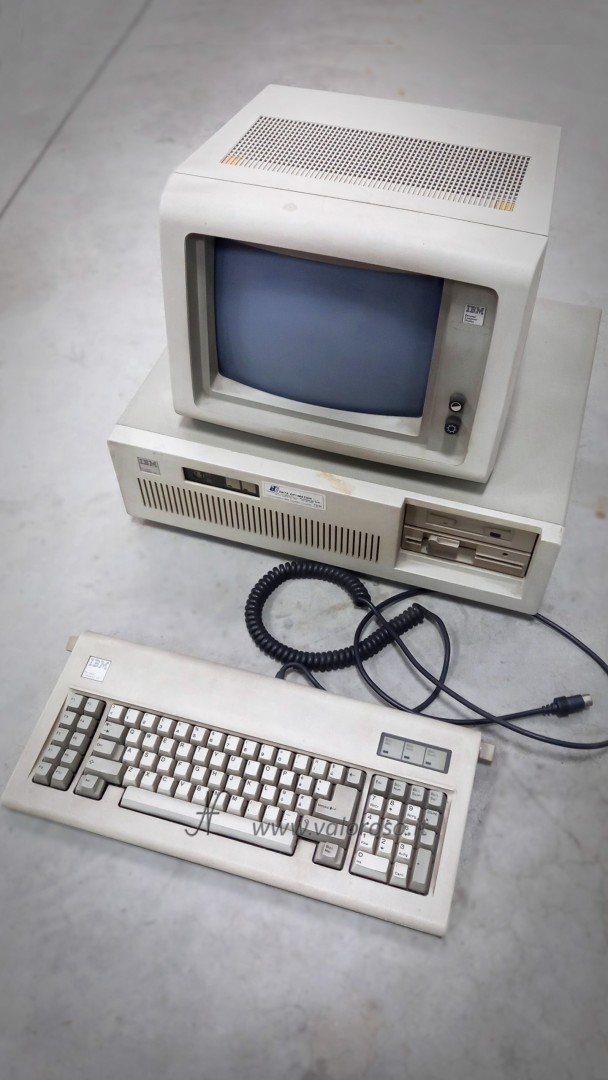
IBM Personal Computer AT 5170, an IBM personal computer in the PC/AT family.
It is certainly one of the most significant items in the entire donation. The PC/AT 5170 is based on the Intel 80286 microprocessor and is a key system in the evolution of IBM-compatible personal computer architecture, as well as being quite rare to find today. In addition to the computer, the manual is also included. The monitor and keyboard are also present and are described below.
IBM 5151 Monochrome Display, IBM monochrome monitor.
The setup is completed by the classic IBM monochrome monitor used with early PC systems. It is one of the elements that makes the complete setup particularly attractive, as it allows an IBM workstation consistent with the period to be recreated.
IBM Personal Computer AT 84-Key Keyboard, a keyboard from the IBM Model F family.
The keyboard has 84 keys, with the function keys arranged vertically on the left and status LEDs. It is the keyboard associated with the early IBM PC/AT configurations and uses the bidirectional interface provided by the AT system.
Having the monitor and keyboard together with the computer makes this IBM PC/AT one of the items I am happiest to have saved.
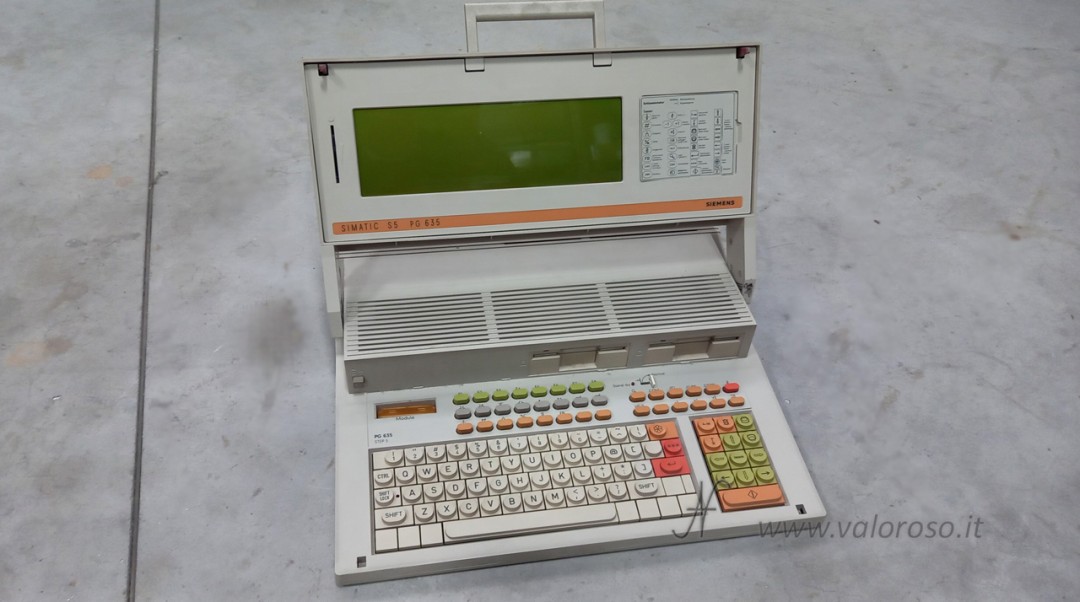
Siemens SIMATIC S5 PG 635, industrial programming unit for SIMATIC S5 PLCs.
The PG 635 is a true portable workstation for industrial automation, with an integrated display, a keyboard with dedicated commands, STEP 5 software and two floppy disk drives. These programming units were used to create, modify, verify and diagnose programs for Siemens SIMATIC S5 family PLCs.
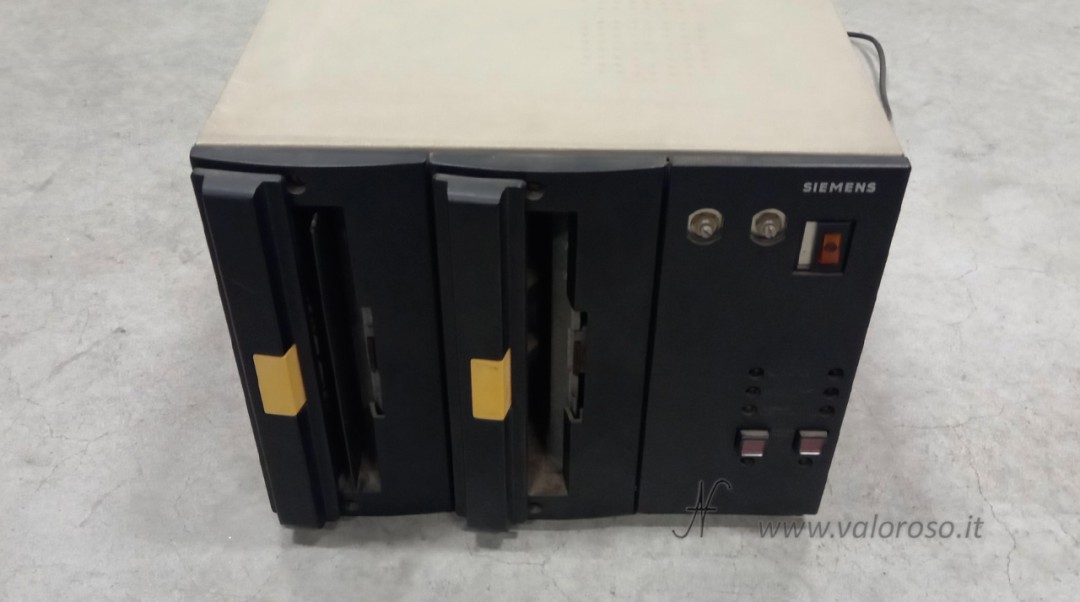
Siemens unit with two 8-inch floppy disk drives.
Another particularly striking item is this large Siemens unit equipped with two 8-inch floppy disk drives. The size of the drives immediately shows how much computing has changed over the years.
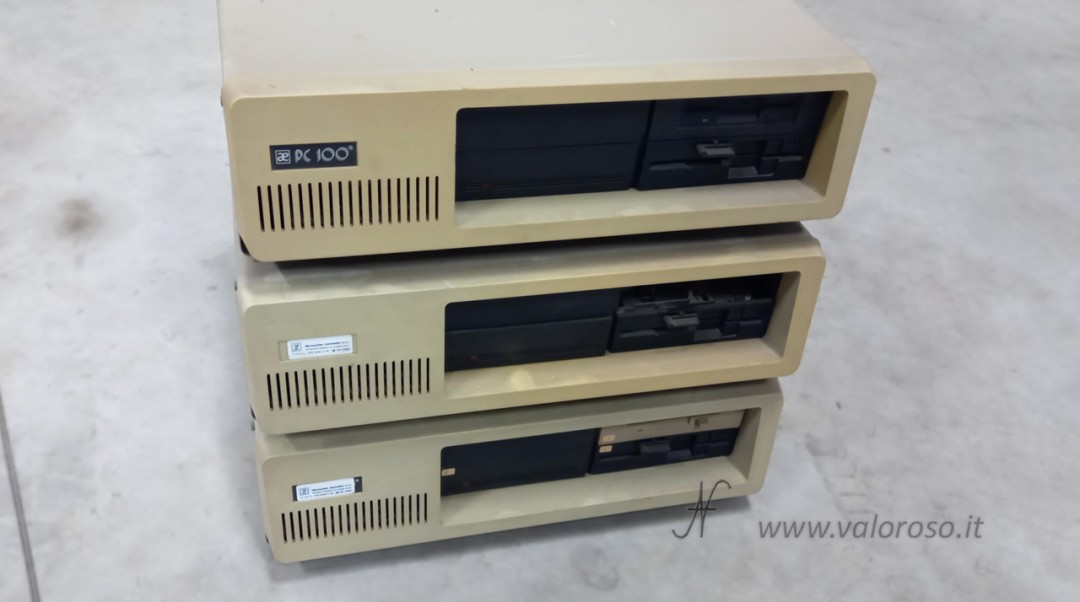
ASEM PC 100, three IBM XT-compatible personal computers.
The donation includes three ASEM PC 100 computers, with desktop cases, floppy disk drives and expansion capability through internal cards.
ASEM is a particularly significant name in the Italian industrial automation and computer sector. The company began in electronic engineering and later also designed MS-DOS-compatible personal computers and systems for industrial applications.
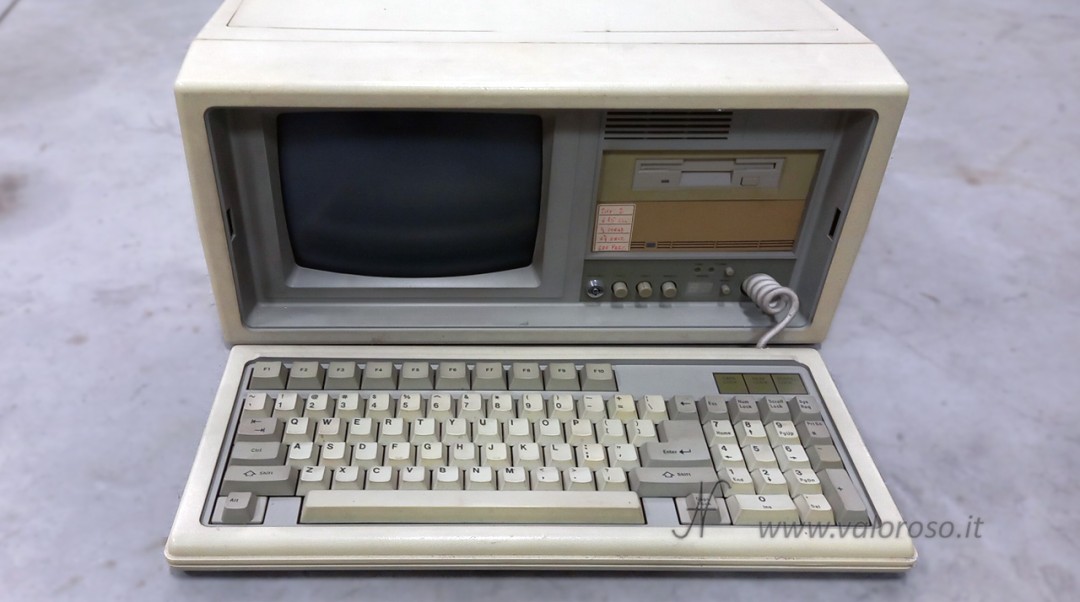
Transportable PC-compatible computer with integrated CRT monitor and removable keyboard.
Another very unusual item is a large transportable, or luggable, computer with a CRT monitor built into the case, front-mounted disk drives, expansion cards and a detachable keyboard connected by cable.
Since no sufficiently legible make or model designation is visible, I prefer not to identify it more precisely for now. It is nevertheless a great example of what making a professional computer portable once meant!
Intel ICE-5100, professional in-circuit emulation system.
An in-circuit emulator allowed the developer to work directly on the electronic system during the design phase, observing and controlling program execution on the actual hardware. The unit received includes the Intel unit, interface boards, the probe and the multiconductor cable.
Intel ICE-196KC/PC, in-circuit emulator for systems based on the Intel MCS-96 family.
The donation also includes material related to the Intel ICE-196KC/PC. Franco used these tools for low-level hardware and firmware development.
Mannesmann Tally MT86, professional dot matrix printer.
A large continuous-form dot-matrix printer designed for professional use. The MT86 is a 136-column machine from a generation of printers built to handle heavy workloads and commonly used in offices and business systems of the period.
Shuttle Spacewalker Mainboard CPU PnP, motherboard for PC-compatible systems.
A Shuttle motherboard kept in its original packaging, with processor, heatsink, expansion slots and memory banks.
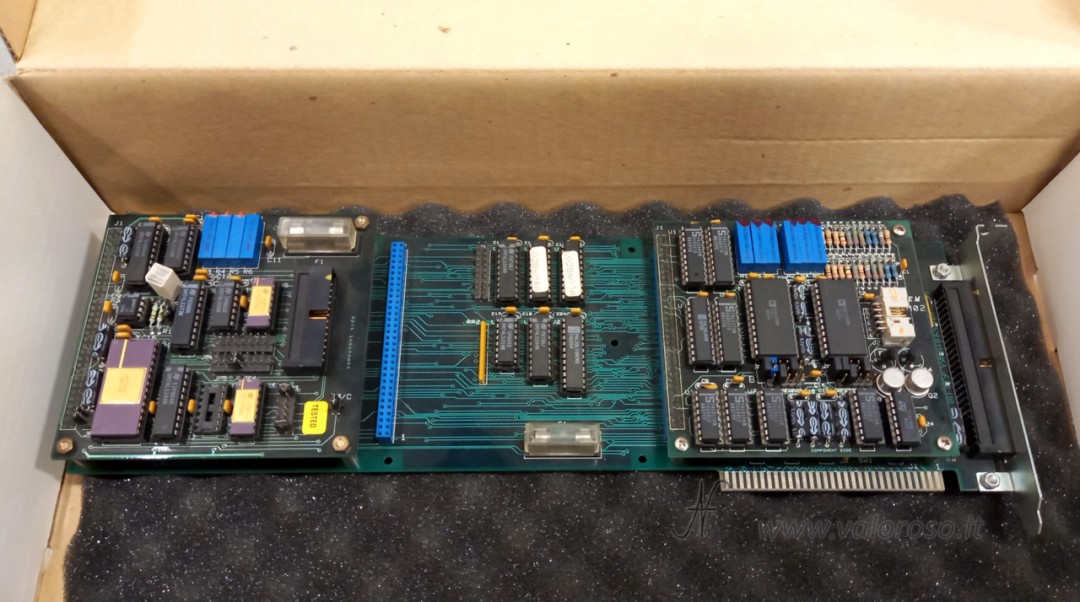
A substantial portion of the donation consists of ISA cards and PC-LabCards used for data acquisition, automation, serial communications and control of external devices.
Advantech PCL-720 Digital I/O & Counter Card, ISA digital I/O and counter card.
PC-LabCard designed to interface digital signals and provide counting functions on a personal computer.
Advantech PCL-743 Dual Port RS-422/485 Interface Card, industrial serial communication card.
There are at least two PCL-743 units in different revisions. The card provides two ports for RS-422/RS-485 communications, standards widely used in industrial automation and for connecting distributed equipment.
Advantech PCL-730, 32-channel Isolated Digital I/O ISA Card.
Card designed for digital interfacing in industrial applications. The PCL-730 combines isolated digital I/O with TTL-level digital lines, providing electrical isolation between the PC and the controlled system.
Advantech PCL-812 Enhanced Multi-Lab Card, multifunction data acquisition card.
It integrates 12-bit analog-to-digital conversion, digital-to-analog conversion, digital inputs and outputs and counting functions. It is therefore a true multifunction interface for acquiring signals from the outside world and controlling devices directly from a PC.
Advantech PCL-670 PC Voice Card, audio and voice card for PC.
The kit is particularly complete: in addition to the card, it includes a manual, software on floppy disk, a microphone or transducer, a speaker and other accessories. It is an interesting example of a multimedia and voice application on a PC before audio functions became standard on every computer.
Advantech PCA-6126, All-in-One 286 CPU Card.
This is not a standard expansion card: it is essentially a 286-based industrial computer implemented on a board, intended for use in a system with the passive backplane described below.
Advantech PCA-6108 Rev. A0 PC-BUS Backplane, 8-slot 16-bit ISA passive backplane.
The backplane makes it possible to build a modular industrial computer: the CPU is installed on a board, while the other slots accommodate I/O, communication and data acquisition cards. The PCA-6108 family consists of eight-slot PC/AT-compatible ISA backplanes.
Kaga Electronics KTE-3800 Model B55 Super Color Graphics Board, graphics card for IBM PC, XT and AT.
Large ISA graphics card preserved with its original documentation. It is a fine example of the video cards used in early IBM-compatible personal computers, before graphics functions were integrated into the motherboard.
IBM VGA-Compatible Video Graphics Controller, ISA graphics card.
Video card for IBM-compatible PCs with a Chips and Technologies chipset and dedicated video memory.
RS-232 Serial Asynchronous Communication ISA card, asynchronous serial interface.
Expansion card for adding RS-232 communications to a PC, complete with its documentation.
What to do with an old computer before disposing of it?
This donation also provides an opportunity to answer a question that many people sooner or later ask themselves: what to do with an old computer?
You may have found old computers in the attic, garage, cellar or a company warehouse. Or perhaps you are clearing out a laboratory, office or industrial building and wondering how to dispose of an old computer that is no longer in use.
Before simply treating it as an old computer to throw away, it is worth checking exactly what it is. Not all computers necessarily have significant monetary or collector value, but some systems, peripherals, electronic boards, manuals, software and professional tools may be historically interesting and worth preserving.
If you are wondering where to donate old computers, or you have decided to donate a vintage computer, give away old computers or donate computer equipment from a collection, laboratory or company, you can contact me.
I am interested not only in complete computers, but also in peripherals, monitors, keyboards, electronic boards, industrial systems, development tools, manuals, original software and other documentation related to the history of computing and electronics.